

introducing op-01.
the first dedicated research mission to study menstruation in space.
OP-01 is a 2027 suborbital research mission led by Manju Bangalore and Priya Abiram through Operation Period’s Redshift Lab flying with Virgin Galactic.
The mission is designed to study menstrual health and fluid dynamics in microgravity, an area of human spaceflight research that remains under-researched.
OP-01 builds upon prior microgravity research conducted by Operation Period and represents a major step toward ensuring the future of spaceflight is designed for everyone.
what is operation period-01 (op-01)?
meet the crew

Meet MANJU
founder + executive director, operation period
manju@operationperiod.org | @astronautmanju
Manju Bangalore is a reproductive health scientist, astronaut-in-training, and researcher leading work at the intersection of human spaceflight and menstrual health. She is the founder of Operation Period, a nationally recognized nonprofit advancing menstrual freedom through science, media, and education.
Bangalore holds a B.S. in Physics and Mathematics from the University of Oregon and a M.S. in Astronautical Engineering from the University of Southern California. She has conducted research on multiple parabolic flight campaigns, including research on menstruation in microgravity. She has also worked at NASA’s Marshall and Johnson Space Centers on propulsion systems and spacecraft interfaces, and previously contributed to science policy in the Obama White House.

Meet PRIYA
Director of Research, Redshift Lab
Priya Abiram is an engineer, astronaut-in-training, and pilot focused on building technologies for human spaceflight that enhance life on Earth. She is the Director of Research at Operation Period and has worked on astronaut life support and spacecraft systems across NASA, Blue Origin, VAST, and Boeing.
Abiram holds a B.S. in Mechanical Engineering and an M.Eng. in Aerospace Engineering from Cornell University. She has conducted research on a parabolic flight campaign and published award-winning work on Mars settlement systems. A U.S. Congressional Award Gold Medalist and former Cadet Lieutenant Colonel in the Air Force Auxiliary, she has earned international recognition for innovations spanning assistive technology, renewable energy, and space-for-Earth solutions. Priya is also a 22 Under 22 honoree by HerCampus and e.l.f. Beauty for her work in STEM.
why this mission matters
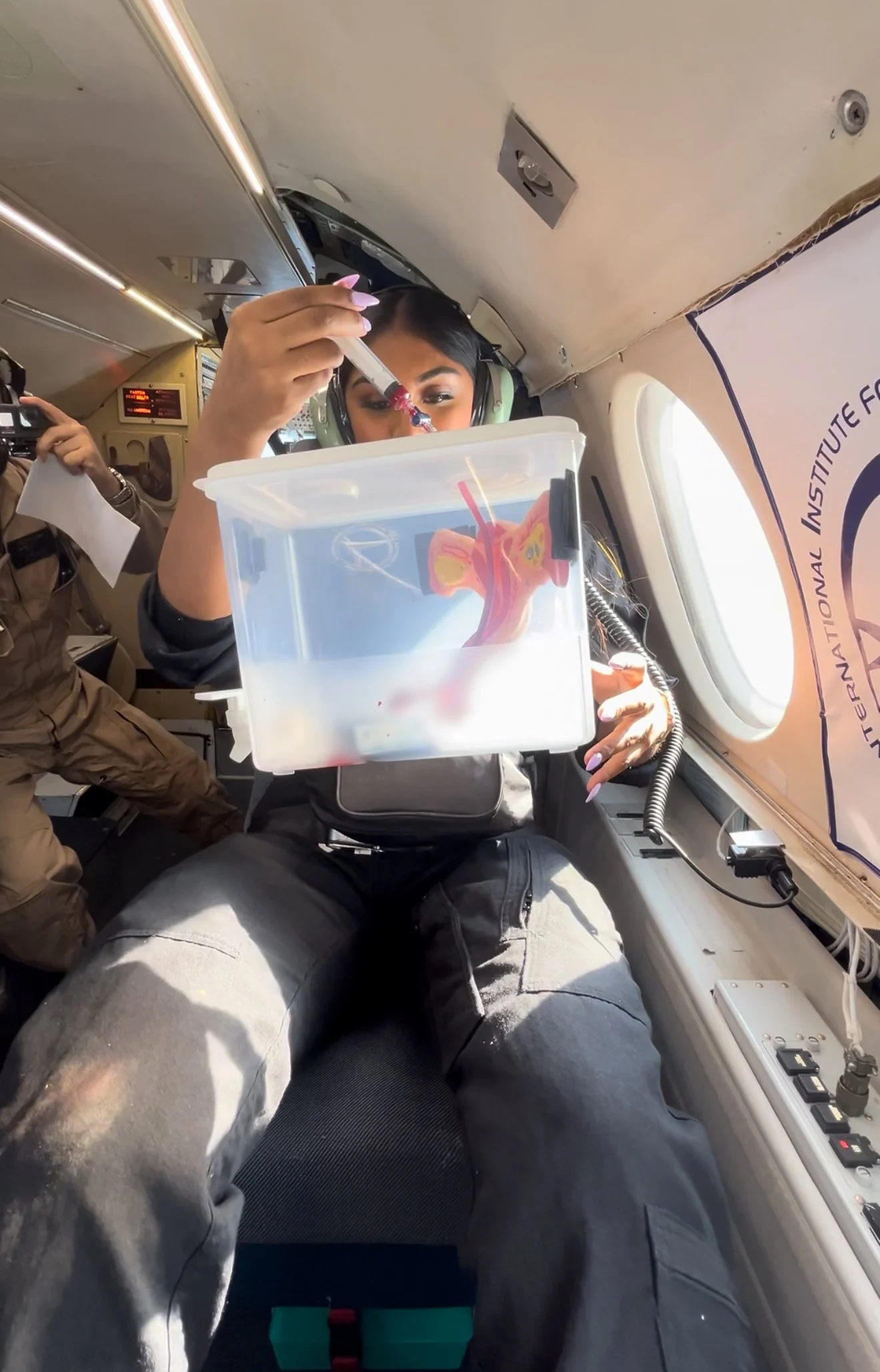
For decades, there has been a narrow model used as the baseline in aerospace medicine and human spaceflight research.
But as more diverse crews participate in space exploration, our systems, biomedical research, and operational planning must evolve alongside them.
Periods have never been quantitatively studied in space before. UNTIL NOW.
The data gathered through OP-01 will help advance understanding of menstrual health in altered gravity environments and may help inform:
biomedical and operational research priorities
long-duration mission planning
broader menstrual health innovation on Earth
This is not a question of whether menstruators can go to space. They already have.
This is about building the research, tools, and systems necessary for a more inclusive future of human spaceflight.
Frequently Asked Questions
-
Historically, many areas of medicine and aerospace research were developed using limited biological models, and menstruation was often operationally managed rather than directly studied quantitatively in spaceflight environments.
OP-01 helps address that longstanding research gap as human spaceflight continues to expand.
-
Existing evidence suggests many astronauts have menstruated in space without major operational complications. The purpose of this research is not to portray menstruation as a problem for spaceflight, but to address a longstanding scientific and systems-design gap in aerospace medicine.
Historically, human spaceflight systems were designed around a relatively narrow astronaut profile. As spaceflight expands to more diverse crews, it is important that spacecraft systems, biomedical research, operational planning, and human factors engineering account for the full range of human physiological experiences.
This is also an autonomy issue. Astronauts should ideally have informed choices regarding whether they menstruate during missions, what products or suppression methods they use, and how those decisions intersect with operational systems and personal health considerations.
OP-01 should be understood as part of the natural maturation of human spaceflight research and human-centered systems design as space becomes more accessible, not as evidence that menstruation is inherently incompatible with spaceflight.
-
Existing reports suggest menstruation may remain largely normal during spaceflight, which is important and encouraging. But those observations are based on limited historical data, not direct quantitative research. Menstruation has never directly and quantitatively been studied in microgravity. As spaceflight expands, it’s important that reproductive health is studied with the same rigor applied to other physiological systems, even when no obvious problem is present.
-
Virgin Galactic provides a unique platform for researchers to conduct hands-on scientific work in microgravity while helping expand access to space research.
This mission aligns with a broader vision of enabling more diverse scientific questions, researchers, and perspectives to shape the future of human spaceflight.
-
No. Existing evidence suggests many astronauts have menstruated in space without major operational complications. The purpose of this research is not to portray women’s bodies as a problem for spaceflight, but to address a longstanding scientific and systems-design gap in aerospace medicine.
Historically, human spaceflight systems were designed around a relatively narrow astronaut profile. As spaceflight expands to more diverse crews, it is important that spacecraft systems, biomedical research, operational planning, and human factors engineering account for the full range of human physiological experiences.
This is also an autonomy issue. Menstruating astronauts should ideally have informed choices regarding whether they menstruate during missions, what products or suppression methods they use, and how those decisions intersect with operational systems and personal health considerations.
OP-01 should be understood as part of the natural maturation of human spaceflight research and human-centered systems design as space is democratized, not as evidence that women are inherently less suited for spaceflight.
-
Space research has historically led to breakthroughs with applications far beyond spaceflight itself.
By studying menstrual physiology in an extreme environment like microgravity, Operation Period researchers may gain new insights into fluid dynamics, menstrual product efficacy, and reproductive health inclusion in aerospace medicine that could help inform future medical technologies on Earth.
Just as importantly, this work helps push reproductive health research into spaces where it has historically been overlooked.